What does Blood Hunger do?
The developer’s Svartrau Town Crier Q&A confirms that hunger can make Coen attack people involuntarily at night. This matters before a conversation as well as before a fight: an NPC can be affected by Coen’s condition even when you intended to speak peacefully.
Keep this distinction in mind when reviewing a consequence. A chosen hostile dialogue response and a hunger-driven loss of control are different explanations for what happened. The day and night guide places this risk within Coen’s changing forms.
Can you feed without killing someone?
The official gameplay reveal describes a choice in how far to drain a human victim: enough to leave them unconscious, or enough to kill them. It also presents creatures and animals as alternative blood sources. An unconscious victim is still an affected NPC; “not killed” should not be read as “no consequences.”
| Decision | What the official explanation establishes |
|---|---|
| Leave hunger unaddressed at night | Loss of control can put NPCs at risk |
| Feed from a human | The amount drained can affect whether the victim survives |
| Feed from a creature or animal | Non-human feeding is a supported option |
How is corruption different from hunger?
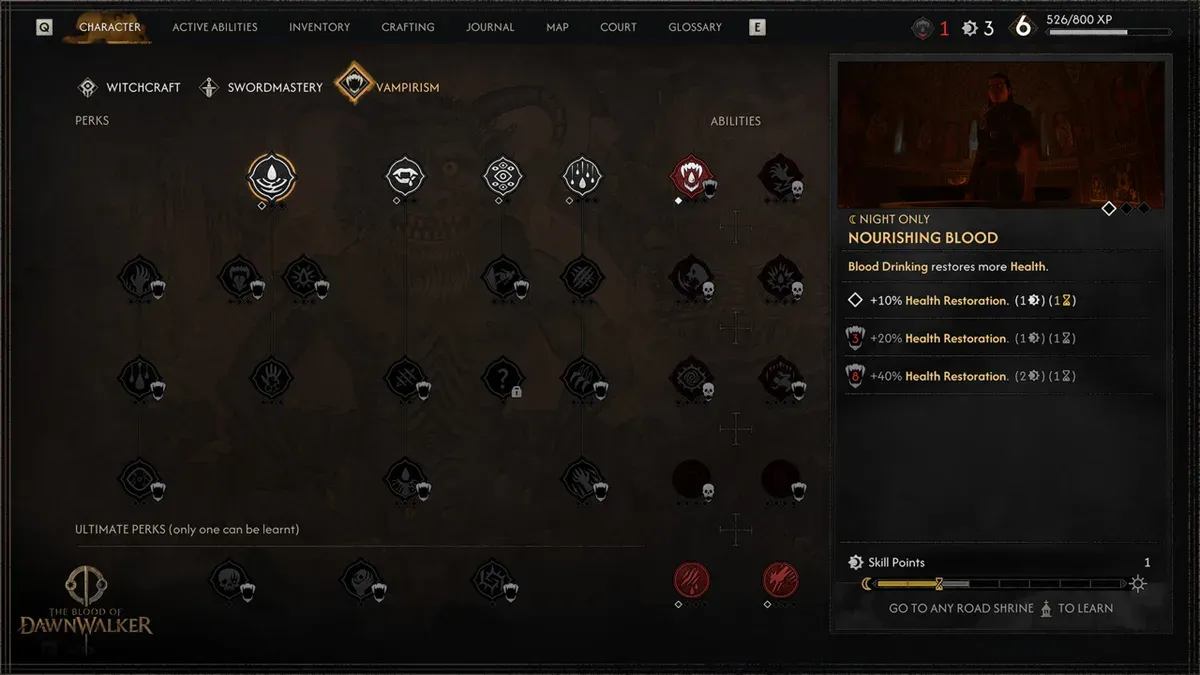
Hunger concerns Coen’s immediate control and feeding needs. Corruption is also part of his development: the Skills & Power bulletin connects consuming blood with access to increasingly powerful vampire abilities. See the skill-tree comparison for the other learning requirements.
The official Q&A does not describe a simple good-versus-evil meter. It frames morality through choices and consequences. A progression requirement therefore does not tell you whether a particular feeding decision will preserve a character or a relationship.
What to check before visiting an NPC
Consider the current phase, Coen’s condition and the consequences you are willing to accept before initiating an important encounter. If a choice also displays an hourglass, review its time cost separately. This page covers the published rule; it does not promise a universally safe feeding route or a particular story outcome.